
The Virtue of Being Vapid: Rachel Sennott’s Unsolvable Satire
Eilidh Paterson
In a recent interview with Variety, Rachel Sennott described her early relationship with Los Angeles as strictly transactional: “I don’t live here. I’m going back [to New York].” For years, LA was a temporary space to pass through rather than a place to settle. The HBO series I Love LA (2025), created by and starring Sennott as Maia Simsbury, is born from that very ambivalence. While it seemingly regurgitates the “making it in Hollywood” trope, it pivots the lens toward an era of influencers rather than film stars. The result isn’t a romanticisation of LA, but a study of four young Angelenos trapped in a cycle of learning, unlearning, and relearning what kind of space they occupy in a constantly shifting city.
At first glance, I Love LA plays like a visual manifestation of what the rest of the world thinks LA is: bland, plastic and rich young adults being offensive, Erewhon as an occasion. It’s obviously not representative of the vast, multicultural city LA actually is. Because the lines between actor and character feel porous – most notably in the casting of Forest Whitaker’s daughter, True Whitaker, as nepo baby Alani – it’s difficult to tell whether Sennott is satirising contemporary culture, or simply representing it. This ambiguity has led many to label the show a “hate watch”. But it’s a hate watch that remains watchable, nonetheless.

Kenny Laubbacher/HBO
I would argue that against the absurdity of I Love LA’s world, where moral didacticism is absent, social politics boil down to nothing. Regardless of whether it should be taken as satire, embodiment, or something else, I Love LA is completely honest about what it is. Like a Gen Z version of Lena Dunham’s Girls, or Sex and the City if Carrie Bradshaw recognized her insufferableness, the show captures social fakeness so knowingly that it inadvertently becomes refreshing.
The spoof may represent a very marginal subset of life, but it’s fiercely dedicated to that subset. It totally grasps how much contemporary culture is built on meaningless distinctions delivered with conviction, such as the New York versus LA hierarchy. “I know you think New York bagels are better, but actually these beat Tompkins or whatever the fuck y’all are eating,” Jordan Firstman’s Charlie promises with unquantifiable gravitas. The language is equally telling. Characters describe one another using algorithm-approved, TikTok-learnt terminology: “She’s your karmic tie”. It’s a sentence that prioritizes vibe over value.
The first episode introduces an ongoing fixation with status, particularly when it’s borrowed, a motif that recurs throughout the series. Maia’s birthday party feels less impressive because it’s secured by frenemy Tallulah (Odessa A’zion). Achievements shrink when they’re adjacent to insecurity, or when they’re not really yours, but characters recover from their problems as quickly as they evolve: emotions are big but are entirely reversible.
Taking the show too seriously by critiquing inaccuracy and overanalysing whether the vapidity of its characters is curated or ripped from reality produces its own shallowness. It subscribes to the idea that media is only worthwhile if viewers can extract something impressive to repeat afterwards – the kind of thinking that might inform a Letterboxd top four. It’s also exactly the mindset the show’s social-climbing characters would adopt themselves. While it’s perhaps an uninspiring take, the show is undeniably best at face value. Over-analysis is exactly what it avoids, presenting characters who care, but only to a point. They care about being liked, cancelled, or admired, yet they openly acknowledge the artifice: “What’s the point in being nice if no one that can help me sees it?”
And by the end of every episode, there’s a familiar realisation: despite the name-dropping and the mutual exploitation, the four friends love each other more than those who hold the promise of further social climbing, such as Elijah Wood and Quen Blackwell, who miraculously appear as themselves in the fourth episode. The show suggests that vapidity is not as much of a moral failure if it is recognized and embraced. Falsity conversely becomes plain honesty, which might even predate depth.
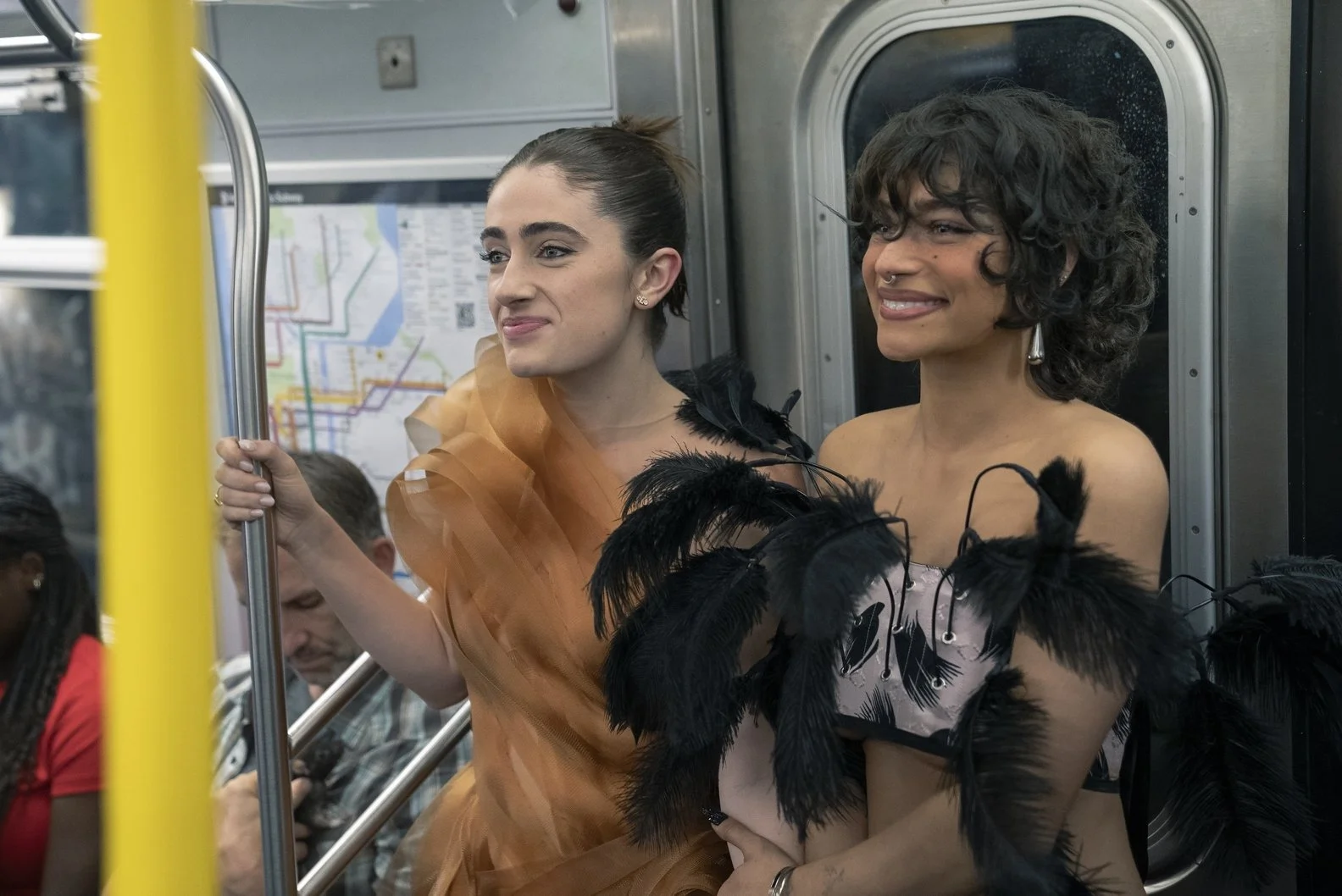
Kenny Laubbacher/HBO
Ultimately, the show’s success lies in its refusal to adopt an anthropological distance. It’s Gen Z-coded media created by the people it depicts. There is no attempt to decode the internet from the outside; instead, translatable glances and micro-expressions make I Love LA play like an inside joke you’re invited into. The characters operate through a series of modern paradoxes: they are self-awarely unaware and desperate to be seen, yet only via a curated, partial view.
It is a show best watched without the baggage of expectation. To approach it with too much critical rigidity is to risk missing the point, and becoming just as insufferable as the characters themselves.
