
A Love Letter to You Sou
★★★★½
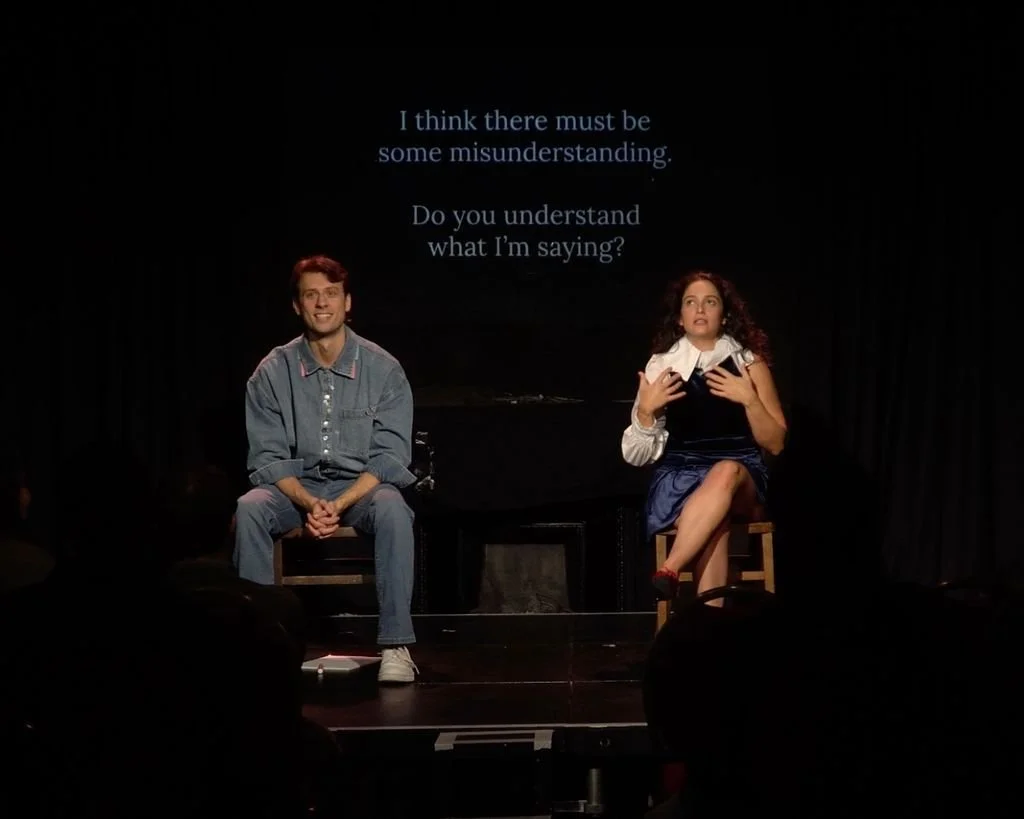
Image via Bruno Águas
Starting this review, I’m struck by the sudden realisation that for anyone reading this, it might already be too late to see You Sou at this Fringe, as it’s only running until 9 August. If that is the case, let what I write serve not as a suggestion to buy a ticket, but first and foremost as a love letter. This show is absolutely brilliant.
You Sou, a bilingual play in both Portuguese and English, is written by its own stars, Carolina Garçāo and Alexander Wardach, and produced by Meraki Theatre and Embuscada. Across three vignettes, three American-Portuguese couples, all played by Wardach and Garçāo, navigate the differences and difficulties that arise in cross-cultural relationships.
The first couple, Isabel and Ben, are adulterous lovers. Ethan and Inês are an engaged couple on the night before their wedding. Paula and William have just been introduced on a Love is Blind-esque dating show in which they can’t see one another. In each subsequent iteration of the intercultural couple, the American man’s ability to speak Portuguese dwindles until the final vignette, where neither can understand one another’s language at all.
The writing is beautiful and honest throughout. The dialogue is sharp and quick, beckoning you to fall into the story and root for the characters. With a threadbare set design and only sparing use of technical effects, all eyes are on Wardach and Garçāo’s performances. And while both are magnetic, sharing obvious chemistry, Garçāo’s performance is especially affecting and heartbreaking.
Perhaps the only drawback of this vignette structure in a one-act piece is that there simply isn’t enough time or material to adequately separate the six characters from any traits other than their nationalities. You could argue that this is intentional, with the audience experience echoing the impossibility of the characters truly knowing one another. Or you could imagine it’s simply a compromise made for the sake of the form. Either way, I was still left in tears at the final bow.
My favourite image of the production is the one I’ll leave you with. In a particularly vital moment in the first vignette, as Garçāo’s Isabel speaks passionately, attempting to bridge the divide in understanding with Wardach, he stands directly in the middle of the audience’s translation, projected onto a screen behind them. In her most desperate moment, trying to get him (and us) to understand, we’re craning our necks and angling in our seats, scrambling to chase a mere translation.
Elena Cebulash
