
“I’m From Brooklyn, That’s Alright”: Revisiting Snipes as Poet
Eilidh Paterson
On the 4th of August, 2012, at Sunshine, Melbourne, a OneOuts event took place which continues to evade categorisation. The two round showdown between the wordsmiths 2Shae and Snipes has amassed 1.2 million views, standing as both an artefact and a compelling argument for avant-garde chaos as an art form. Here, I will explore Snipes’ rebuttal that begins at 0:02:29 not as a punchline, but as a juggernaut of poetry and an heir to a literary tradition older than the rap itself.
“I’m sorry little kids, but imma kill a clown today”, snipes begins, full of regret. The opening line confirms that we are witnessing something unprecedented, provoking interpretation and possibly even prophecy. Is he implying “I’m a killer clown today”? If so, Snipes pre-empted the Killer Clown epidemic of October 2016. More likely, however, the line is literal: “I am going to kill a clown”. 2Shae is the clown destined for termination and the promise is thrilling.
Next comes the pivotal declaration: “I could say bullets gonna spray” and miraculously “today/spray” gives us a rhyming couplet. For a moment, language holds.
Yet what follows is discordant jargon, remiss versification. “I’m from Brooklyn, that’s alright…” Snipes haphazardly announces. It’s okay to be from Brooklyn (Australia), Snipes assures, but is it okay to follow “spray” with “alright”? It marks a riveting destruction of barriers. He opens loosely, with an AABA rhyme scheme — languid, yet undeniably there.
Repeated five times, the plea “But, lemme just say this” becomes a cry of artistic purpose and a key motif. Snipes demands the floor, though he already has it. At one point, an onlooker’s dog whines, and Snipes’ flow state collapses. He is not losing language – it is losing him.
Consider:
The reason I call myself Snipes is because I take my time to rhyme
I’m not complicated
But I’m like a sniper
These lines elicit rare hints of assonance. Crucially, “I take my time to rhyme” is a promise that the performance fulfils almost too literally as we await scraps of rhyme. Toward the conclusion, there is a glimmer of hope in the pairings “death” and “meth-head”, but not enough to place Snipes’ oratory with traditional rap.
There’s something wonderful in this wild and elevated battle rap. Onlookers hide behind their hands, commenters treat Snipes as a figure of ridicule, yet what they mock, they fail to understand.
The clumsy grandeur sparked a surprising literary lineage for me. Leigh Hunt’s The Story of Rimini – a nineteenth-century sympathetic recasting of Dante’s hellish lovers – led John Gibson Lockhart to establish Hunt – a man of “extreme moral depravity” – as the founder of a Cockney school of poetry (see Blackwood’s Edinburgh Magazine, “On the Cockney School of Poetry” 1817). This derogatory grouping would also extend to the likes of Keats and Hazlitt.
John Wilson Croker too was horrified at Hunt’s display of “ungrammatical, unauthorised, chaotic jargon” (see Quarterly Review, “Leigh Hunt’s Rimini”, 1816). The poet diluted the gravitas of his theme with superfluous descriptions and colloquial language, a far cry from traditional neoclassical neatness.
So, is Snipes perhaps a modern version of the Cockney poet?
This battle suggests yes.
Snipes wishes death upon his opponent with chaotic syntax that defies the stability of grammar. In true Cockney fashion, he delivers his “extreme moral depravity” via linguistic landslide:
Instead of Heath Ledger dying
Why don’t you replace his … death
Snipes stumbles mid-sentence, as though chasing his own thoughts up a stair master. His jargon is so unwieldy that he utters “fuck” into the void, overwhelmed by the poem he is creating in real time.
Traditional form crumbles and a plethora of contradictions crop up. The cluster “I like to get close and personal/ With a razor-sharp object” seems like a promise Snipes will easily fulfil when he threatens to “grab a pen”. However, moments later, Snipes mentions a “blunt object” and his prophecy shatters. Sharp becomes blunt. Threat becomes stationery. He proceeds to assert “I’m not gonna stab you in the heart”, then vows: “I aim straight for the heart”. Not even Snipes is safe from Snipes. Additionally, the claim “I’m not complicated” arrives during one of the most enigmatic vocal performances ever recorded.
Snipes does not loosen poetic form, he abandons it. He is, arguably, the Cockney poet of OneOuts: a breaker of structure, a pioneer of jagged stanza. 2Shae claps back with the devastating critique, “This boy came with rhymes like that hoping he'd win… hell no” parroting the voices of Lockhart and Croker. But Snipes exists beyond rhyme, rapping about the menace of murder with the reverberation of an apology.
The Cockney poets were initially ridiculed, their poetry deemed offensive and uncouth, before this engendered a redefining literary school. With little to no punchlines and almost no rhymes, Snipes too rejects almost everything associated with battle rap. Therefore, lemme just say this, it is utter ahead-of-its-time genius.
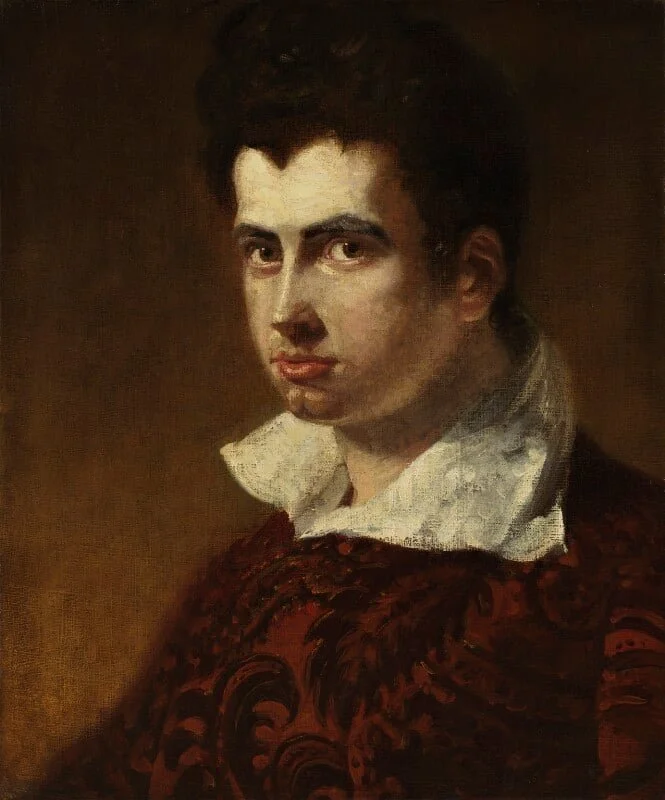
Leigh Hunt, by Benjamin Robert Haydon, c.1811.
Via National Portrait Gallery, London.
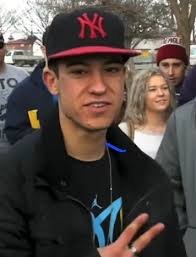
Snipes.
Image via VerseTracker
