
Pen or Pixel — Is This the Death of Handwriting?
Mali Delargy
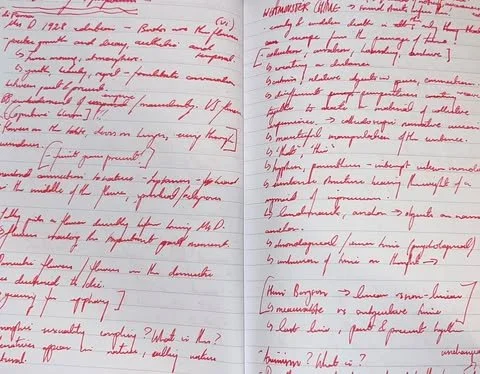
(Fig 1 - my handwriting)
My handwriting may not be ugly, but it is illegible and always has been. It’s the product of copying my two closest friends in primary school, who had completely different hands. My essay feedback was always a red underline and a single note: handwriting! After one GCSE History exam, I remember showing my friends how I scrawl the word communism quickly. On a keyboard, it would translate to something like ‘commmmmsm’, with a dot hovering ambiguously in the middle.
For me, student journalism has meant reviewing theatre or events, which requires fast note-taking, often done in the dark. This, and perhaps writing Christmas cards, is the only time I write with a pen. Having mostly online assignments, I am forced to use my laptop. I find myself asking, however: Can the modern keyboard, instant and effortless, replace pen and paper? If so, have handwriting and spelling become dying art forms?
Recent trends might suggest that they are on a path to obsolescence, but I would argue that typing and handwriting ultimately serve different purposes. Typing pursues efficiency, while handwriting offers experience. As with the keyboard, the brain, the eye, the page and the hand are all involved in handwriting. The difference is the speed. In lectures, I can almost verbatim transcribe a lecturer’s words on my laptop, but by hand I must summarise (and process) their words. I would have to write out any quotes, not just copy and paste from a power point. It seems that the pen fosters engagement while the keyboard is merely a copout.
Handwriting holds a personal history. My copy of Virginia Woolf’s To the Lighthouse holds a particularly lovely note from my mother, travelling in Japan when she was my age:
“Margred. Chwefror y 23ain, — 1991.—
Penblwydd Mamgu heddi.
— HIROSHIMA. —”
The pages, now yellowed, have been leafed through time and time again. Her note adds an element of imagination, knowing whose hands have touched the same spot. I can imagine her simple pleasure of skin to page contact. Perhaps she wrote it with me in mind.
Her note is written in Welsh, a language where spelling is phonetic. I blame this, paired with my illegible handwriting where individual letters scarcely exist, for my rudimentary English spelling. A fake Cambridge study, circulated on the internet, claimed that the first and last letter of a word is all that is necessary for a sentence to be legible. While there is some truth in this, the wider claim was debunked. In this case, my handwriting — which banks on its illegibility to avoid spelling errors — may not stand up to public testimony.
The word-processor may have saved me from academic mishap, but I can’t help feeling a loss. I may not have a natural skill for spelling, but I have a great appreciation for etymology and language-learning. There are, for instance, peculiar similarities between Welsh and French: fenêtre and ffenest for ‘window’, douleur and dolur for ‘pain’. When the word-processor quietly corrects our errors, it cuts us out of the natural development of language. Spelling shows history’s thinking process, just like handwriting shows ours. It would be a shame to miss it.
The British Library holds the manuscript for A Tragedy on the History of Sir Thomas More (1603-1604), in which ‘Hand D’, appearing in secretary hand on three pages, has been identified as Shakespeare’s. Other than only six instances of his signature on legal documents (spelt differently in each instance), this is the only example of his handwriting preserved in time. Naturally, the mind turns from word to pen to hand to person, and the imagination runs wild.
Without handwriting, how would we catch a cheat or admire an elegant hand? What about classroom politics between the left and right-handed? Where would the joy in experimenting with one’s signature go? I remember as kids flaunting our new signatures to one another, covering pages and pages to show off and explore our own personal brand.
I still think about this whenever I write mine. There is something whimsical in it, maybe because it happens so infrequently. Handwriting is a practice, slowly slipping from our collective periphery. Like silverware, if it isn’t polished enough, it will tarnish, and its beauty will be lost to time.
